

Chemistry
Chemistry is the study of substances, what they are made of, how they interact with each other and the role they play in living things. This A Level course is a fascinating exploration of atomic structure, chemical bonding, and reactions of organic and inorganic chemicals, and builds on knowledge and understanding from GCSE. The subject is academically rigorous but hugely rewarding, and students learn the value of chemistry in both subject and application, the impact it has on society and how it may be used responsibly.
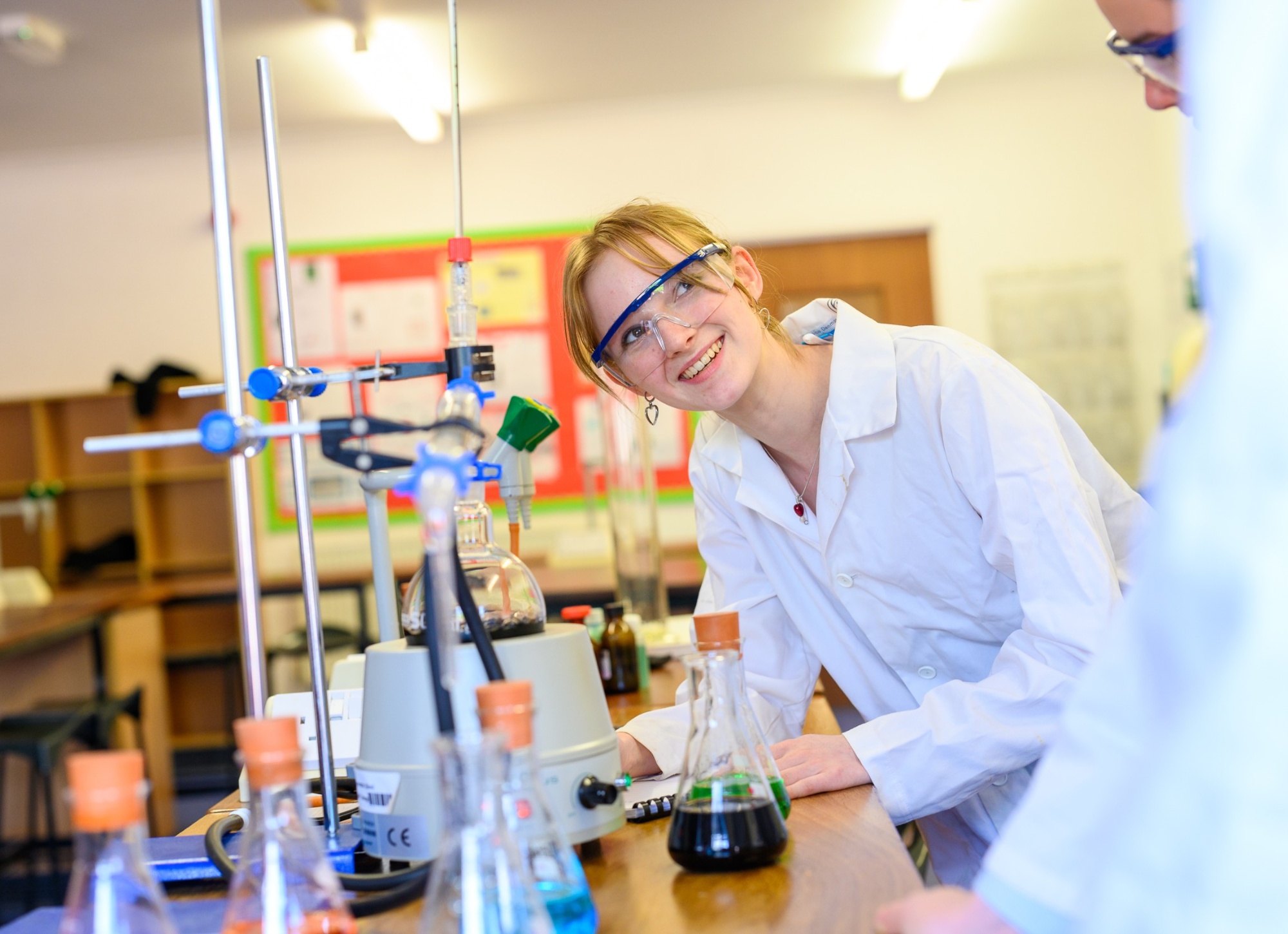
Course content
This two-year course covers physical, inorganic and organic chemistry, with core practicals embedded into the teaching. Year 12 covers atomic structure and bonding; energetics, kinetics and redox; Group 2 alkaline earth metals and Group 7 halogens; and organic functional group chemistry. Year 13 covers thermodynamics and equilibrium; acids and bases; Period 3 and transition metal chemistry; functional group chemistry; and organic synthesis and analysis.
Entry requirements and skills
A GCSE Grade 8 or above is required in Chemistry due to the rigours of the course. Separate (rather than combined) GCSE Chemistry is highly recommended as a precursor. In exceptional cases, applicants with a Grade 7 may be considered. At least 20% of the marks require mathematical skills at least at higher tier GCSE level.
Assessment
All content is examined at the end of the two-year course. Paper 1 covers inorganic chemistry, certain physical chemistry topics and relevant practical skills (2 hours, 35%). Paper 2 covers organic chemistry, certain physical chemistry topics and relevant practical skills (2 hours, 35%). Paper 3 can cover any content and any practical skills (2 hours, 30%). Practical skills are assessed through 12 practicals, internally assessed and externally moderated, and reported as a separate practical endorsement that does not contribute to the A Level grade.
Enrichment
- Journal Club (Years 12 and 13)
- CREST Awards (Years 7–13)
- The Department also organises regular trips including international excursions to the European Space Centre in Belgium, Wakehurst Place and the home of Charles Darwin, Down House.
Future pathways
Chemistry underpins a wide range of science-based degrees and careers, preparing students for futures in chemistry, pharmacy, pharmacology, chemical engineering, biochemistry, biomedical sciences, medicine and dentistry.
A Level Chemistry FAQs
What exam board is A Level Chemistry?
The course follows the AQA Chemistry specification (7405).
What are the entry requirements for A Level Chemistry?
A GCSE Grade 8 or above in Chemistry is required due to the demands of the course. Separate (rather than combined) GCSE Chemistry is highly recommended. In exceptional cases, applicants with a Grade 7 may be considered. At least 20% of the marks involve mathematical skills at higher tier GCSE level.
What topics are covered in A Level Chemistry?
The course covers physical, inorganic and organic chemistry. Year 12 includes atomic structure and bonding, energetics, kinetics and redox, Groups 2 and 7, and organic functional group chemistry. Year 13 includes thermodynamics and equilibrium, acids and bases, Period 3 and transition metal chemistry, functional group chemistry, and organic synthesis and analysis.
How is A Level Chemistry assessed?
All content is examined at the end of the two-year course across three written papers. Paper 1 (2 hours, 35%) focuses on inorganic chemistry, Paper 2 (2 hours, 35%) on organic chemistry, and Paper 3 (2 hours, 30%) can cover any content and practical skills.
Is there a practical assessment in A Level Chemistry?
Yes. Students complete 12 practicals during the course to demonstrate competency. Practical skills are internally assessed and externally moderated, and reported as a separate practical endorsement that does not contribute to the A Level grade.
What careers and degrees can A Level Chemistry lead to?
Chemistry underpins science-based degrees and careers including chemistry, pharmacy, pharmacology, chemical engineering, biochemistry, biomedical sciences, medicine and dentistry.